
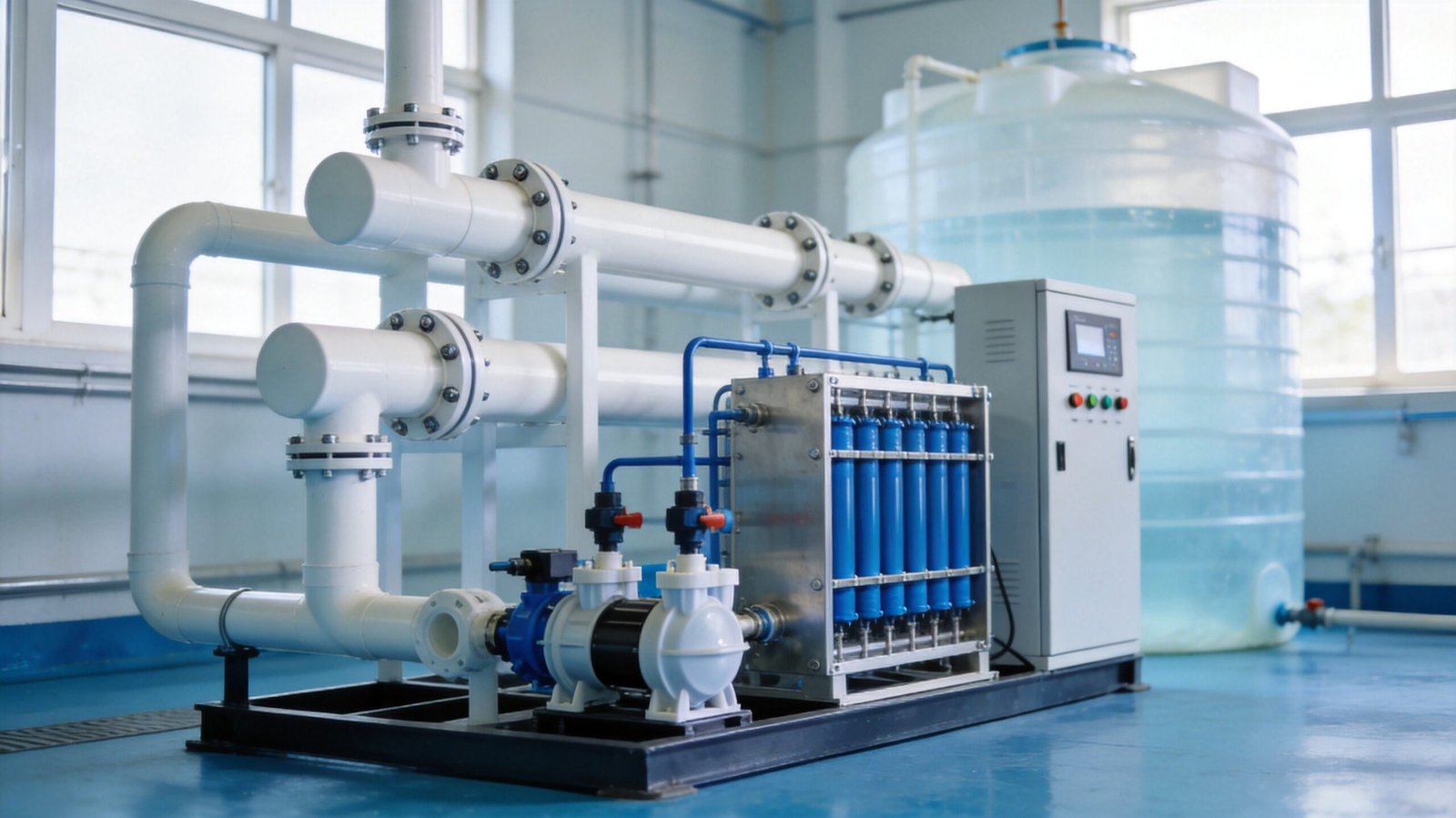
Choosing the right sodium hypochlorite materials of construction is one of the most underestimated decisions in a high-concentration (10–15%) on-site generation project. The same electrolyzer, storage tank, and dosing hardware that survives years of service on a 0.8% municipal electrochlorination system can fail in months — sometimes weeks — when exposed to 10–15% available chlorine. Higher oxidizing power, elevated pH, residual caustic, and accelerated decomposition chemistry all attack wetted components far more aggressively. This guide walks through the engineering logic behind material selection for every wetted part of an ion-exchange membrane sodium hypochlorite generator: metals, thermoplastics, elastomers, and component-level choices for piping, valves, pumps, tanks, and the electrolyzer itself.
Why High-Concentration Sodium Hypochlorite Is So Corrosive
Commercial and on-site-generated 10–15% NaOCl is not simply a stronger version of low-concentration product. Several compounding factors change the corrosion picture fundamentally:
- Oxidation-reduction potential (ORP): High-strength hypochlorite typically exhibits an ORP above +850 mV, enough to break down the passive oxide layer on most stainless steels and attack many common elastomers.
- High pH and free caustic: Product from an ion-exchange membrane generator typically sits at pH 11–13 with 0.1–1% excess NaOH, which keeps the hypochlorite ion stable but is itself aggressive to some metals and polymers at elevated temperature.
- Catalytic decomposition: Trace nickel, copper, cobalt, and iron — exactly the ions released when inappropriate metals corrode — catalyze NaOCl decomposition into chlorate and oxygen. A corroding fitting therefore doesn’t just fail mechanically; it actively degrades your product and inflates chlorate by-product levels.
- Temperature sensitivity: Both corrosion rates and hypochlorite decomposition roughly double with every 10°C rise. A material that is “acceptable” at 20°C may be unsuitable at 35–40°C inside an electrolyzer outlet line.
The practical conclusion: every wetted surface between the brine saturator and the dosing injection point must be selected as a system, not component-by-component from a generic catalog.
Metals in Hypochlorite Service: Titanium Yes, Stainless No
Titanium and Titanium-Palladium Alloys
Titanium Grade 2 is the reference metal for high-concentration hypochlorite service. Its stable, self-healing TiO₂ passive film is actually strengthened by oxidizing environments, giving it excellent resistance to NaOCl even at elevated temperature. In a membrane generator, titanium is non-negotiable in one location: the electrolyzer cell, where commercially pure titanium serves as the anode substrate beneath the mixed-metal-oxide (DSA) coating, typically RuO₂/IrO₂. Titanium fasteners, thermowells, and small machined fittings are also acceptable where a metal part is unavoidable.
For creviced geometries — threaded joints, gasket grooves, areas under deposits — titanium-palladium alloy (Grade 7) offers meaningfully better crevice-corrosion resistance at a modest cost premium and is worth specifying in the hottest sections of the cell outlet.
Why Stainless Steel Fails
The single most common specification error we see in retrofit projects is “upgrading” hypochlorite lines to 316L stainless steel. It feels like a conservative choice — and it fails on two fronts. First, chloride plus strong oxidizer plus crevices guarantees pitting and crevice corrosion, often within months. Second, the iron, nickel, and chromium ions released catalyze product decomposition, raising chlorate levels and gas evolution in storage. 304, 316L, duplex 2205, and even super-duplex grades are all unsuitable for wetted 10–15% NaOCl service. Nickel alloys such as Hastelloy C-276, which excel in reducing acids, are also poor performers in oxidizing hypochlorite and should not be substituted.
Metals to Avoid Entirely
Carbon steel, copper, brass, bronze, and aluminum have no place in wetted hypochlorite service at any concentration above dilute. Beyond corrosion, copper and its alloys are among the most powerful decomposition catalysts. Even non-wetted hardware matters: a corroding brass ball valve on a sample line can contaminate an entire product batch. External structural steel and fasteners may be 316 or coated carbon steel, provided they are fully isolated from drips and fumes with proper ventilation.
Thermoplastics: The Workhorse Materials
Because metals are so limited, thermoplastics carry most of the fluid-handling load in a high-concentration generator. Each has a defined envelope of temperature, pressure, and mechanical duty.
CPVC — The Default Piping Material
Schedule 80 CPVC is the industry standard for hypochlorite piping. It resists 10–15% NaOCl at temperatures up to roughly 90°C and is solvent-welded, economical, and widely available. Two cautions: CPVC pressure ratings de-rate sharply with temperature (at 60°C, allowable pressure is only about a quarter of the 23°C rating), and pipe support spacing must be tightened versus water service because CPVC creeps and sags when warm. Use hypochlorite-rated solvent cement and primer, and always flange the connections at pumps, cells, and tanks for maintenance access.
PVDF — For Hot, Critical, and High-Purity Lines
PVDF handles hypochlorite to approximately 120°C and offers superior abrasion and permeation resistance. It is the preferred choice for electrolyzer outlet headers (the hottest hypochlorite in the plant), dosing injection quills, small-bore tubing, and any line that sees frequent thermal cycling. Its higher cost is easily justified in these critical zones.
HDPE and XLPE — Storage and Day Tanks
Rotationally molded high-density polyethylene, and especially cross-linked polyethylene (XLPE), is the default for atmospheric product storage. As covered in our storage tank design guide, XLPE tanks must be vented, UV-protected or indoor-located, and specified with a hoop stress rating appropriate for the 1.2+ specific gravity of high-strength product. PP (polypropylene) serves well for smaller day tanks and fabricated sumps.
PTFE and PFA — Seals, Liners, and Diaphragms
PTFE is chemically inert to hypochlorite at any practical temperature. Its roles are specific: valve seats, pump diaphragms, gaskets (including PTFE-envelope flange gaskets), sight-tube liners, and expansion joints. PFA tubing handles instrument connections. Remember that PTFE is not an elastomer — it creeps under load — so flange torque and re-torque procedures matter.
FRP with Vinyl Ester Liner — Large Tanks and Scrubbers
For large-volume storage and hydrogen off-gas scrubber towers, FRP with a premium vinyl ester corrosion barrier (resin-rich inner veil plus structural filament winding) is the proven construction. Specify a hypochlorite-rated vinyl ester grade; general-purpose polyester liners blister in oxidizing service.
Elastomers and Gaskets: EPDM vs FKM
Elastomer selection is where many otherwise well-designed plants develop chronic leaks. The oxidizing, high-pH environment destroys the wrong rubber quickly:
- EPDM (preferred): Excellent resistance to NaOCl across the full concentration and temperature range of generator duty. Standard for flange gaskets, O-rings, and diaphragm-valve membranes (usually with a PTFE face on the wetted side).
- FKM (severe duty): Appropriate for the hottest sections, highly oxidizing spots such as cell outlet manifolds, and where longer service intervals justify the cost.
- Avoid: Nitrile (NBR), natural rubber, and butyl rubber all harden, crack, and leak — butyl gaskets in particular are a frequent root cause of flange failures in hypochlorite service. Neoprene is marginal and should not be specified for new systems.
A simple procurement rule eliminates most field failures: default to EPDM, upgrade to FKM above 50°C or on critical joints, and ban NBR and butyl from the bill of materials.
Component-by-Component Material Selection
Electrolyzer Cell
The cell is the harshest environment in the plant: hot (35–45°C) hypochlorite, wet chlorine gas on the anode side, caustic on the cathode side, and DC electrical potential. Proven construction is titanium anode substrate with RuO₂/IrO₂ DSA coating (see our article on electrode coating technology), CPVC or PP cell frames, the cation-exchange membrane itself, and EPDM or FKM cell gaskets. Spacers and tie-rod isolation sleeves should be PTFE. The acid-cleaning circuit (1–3% HCl for scale removal, as described in our maintenance guide) must also be CPVC or PVDF with EPDM seals — never stainless.
Piping, Valves, and Fittings
- Brine lines: CPVC is fully adequate; softened and purified brine (see our brine purification guide) is far less aggressive than product.
- Product lines: CPVC Sch 80 at ambient, PVDF for hot cell outlets and dosing skids.
- Ball valves: True-union CPVC with PTFE seats and EPDM O-rings for isolation.
- Diaphragm valves: CPVC or PVDF body with PTFE-faced EPDM diaphragm for throttling and dosing duty.
- Check valves: PVDF spring or ball checks with FKM seals on injection points.
- Strainers and sight glasses: CPVC/PP housings with EPDM seals; acrylic or PVC sight tubes only where shielded.
Pumps and Dosing Equipment
Sealless magnetic-drive centrifugal pumps with PP or PVDF wetted housings eliminate the mechanical-seal failure mode entirely and are preferred for transfer duty. For metering, diaphragm pumps with PTFE diaphragms and PVC/PVDF liquid ends are standard — full selection logic is covered in our dosing pump selection guide. Avoid stainless pump heads “because they’re stronger” — they are not, in this chemistry.
Instrumentation and Small Wetted Parts
ORP and pH electrodes should have PVDF or PTFE bodies; flow meters should be mag meters with PTFE/PFA liners and tantalum or titanium electrodes, or plastic variable-area types. Pressure gauges and transmitters require PTFE-isolated diaphragm seals with PVDF or PTFE process connections — never direct-mounted stainless. Sample lines in PVDF or PTFE tubing complete the loop.
Sodium Hypochlorite Materials of Construction: Quick-Reference Table
| Component | Recommended | Acceptable | Never Use |
|---|---|---|---|
| Electrolyzer anode / cell hardware | Titanium Gr2 + DSA coating | Ti-Pd (Gr7) in crevices | Any stainless, nickel alloy |
| Product piping (ambient) | CPVC Sch 80 | PP, PVDF | 304/316L, carbon steel, copper |
| Product piping (hot, cell outlet) | PVDF | CPVC (de-rated) | FRP process pipe (unlined) |
| Storage tanks | XLPE / HDPE | FRP + vinyl ester liner, PP | Steel, unlined FRP |
| Flange gaskets / O-rings | EPDM | FKM (hot/critical), PTFE envelope | NBR, butyl, natural rubber |
| Valve seats / diaphragms | PTFE | PTFE-faced EPDM | Elastomer-only seats |
| Pump wetted ends | PP/PVDF mag-drive, PTFE diaphragm | CPVC centrifugal | Stainless heads, NBR seals |
| Instrument wetted parts | PVDF / PTFE | Titanium electrodes | 316L insertion fittings |
Common Material Mistakes in High-Concentration Systems
After commissioning and servicing dozens of plants, the failure patterns repeat. Watch for these in your own designs and bids:
- The stainless “upgrade” trap — substituting 316L where plastic was specified, triggering both corrosion and product degradation.
- Brass or bronze on “non-critical” lines — sample valves, drain cocks, and hose barbs catalyze decomposition out of proportion to their size.
- Wrong gasket rubber — NBR or butyl flange gaskets that weep within a quarter; replace with EPDM across the board.
- Galvanic couples — titanium cell hardware bolted directly to steel frames without isolation; crevice attack follows.
- Ignoring temperature de-rating — CPVC lines sized on ambient-temperature pressure ratings fail at the cell outlet on hot days.
- Unrated hoses and adhesives — clear braided PVC hose and general-purpose solvent cement degrade in high-strength product; use hypochlorite-rated consumables only.
Conclusion
Sound sodium hypochlorite materials of construction are what separate a high-concentration generator that runs a decade from one that leaks, contaminates product, and erodes confidence in on-site generation. The rules are consistent: titanium where metal must touch product, CPVC and PVDF for piping, XLPE and lined FRP for tanks, EPDM or FKM for every gasket, and PTFE for seats and diaphragms — with stainless steel, copper alloys, and nitrile rubber excluded from the wetted envelope entirely.
At QINGYAU, material selection is engineered into every high-concentration sodium hypochlorite generator we deliver, from the DSA-coated titanium electrolyzer to the last flange gasket. If you are specifying a new plant or troubleshooting material failures in an existing one, start with our complete guide or contact our engineering team for a project-specific materials review.
Further reading: The Chlorine Institute publishes authoritative pamphlets on hypochlorite handling, and AMPP (formerly NACE) maintains corrosion-resistance references for oxidizing chemistries.