
In industrial and municipal water treatment applications, where robust disinfection capabilities are essential, high-concentration sodium hypochlorite generators have revolutionized on-site chemical production. These sophisticated systems produce sodium hypochlorite solutions with significantly higher available chlorine concentrations than standard models, offering enhanced performance for demanding disinfection requirements.
## The Enhanced Electrolysis Process for High-Concentration Production
While high-concentration sodium hypochlorite generators utilize the same fundamental electrolysis principle as standard models, they incorporate advanced technologies to achieve greater concentrations. The process begins with a more concentrated brine solution (typically 20-30% NaCl compared to 2-5% in standard systems), which serves as the feedstock for the electrolytic cell.
The core electrochemical reactions remain consistent:
– At the anode: 2Cl⁻ → Cl₂ + 2e⁻ (chlorine gas evolution)
– At the cathode: 2H₂O + 2e⁻ → H₂ + 2OH⁻ (hydrogen gas and hydroxide ions)
– In solution: Cl₂ + 2OH⁻ → ClO⁻ + Cl⁻ + H₂O (formation of hypochlorite ions)
However, high-concentration systems optimize these reactions through:
– Advanced electrode materials and configurations that enhance reaction efficiency
– Precise control of temperature, current density, and flow dynamics
– Specialized membrane technologies that separate the anode and cathode compartments
– Optimized brine concentration and flow rates tailored for higher product output
These enhancements enable production of sodium hypochlorite solutions with 3-8% available chlorine, significantly higher than the 0.8-1.2% concentrations typical of standard systems.
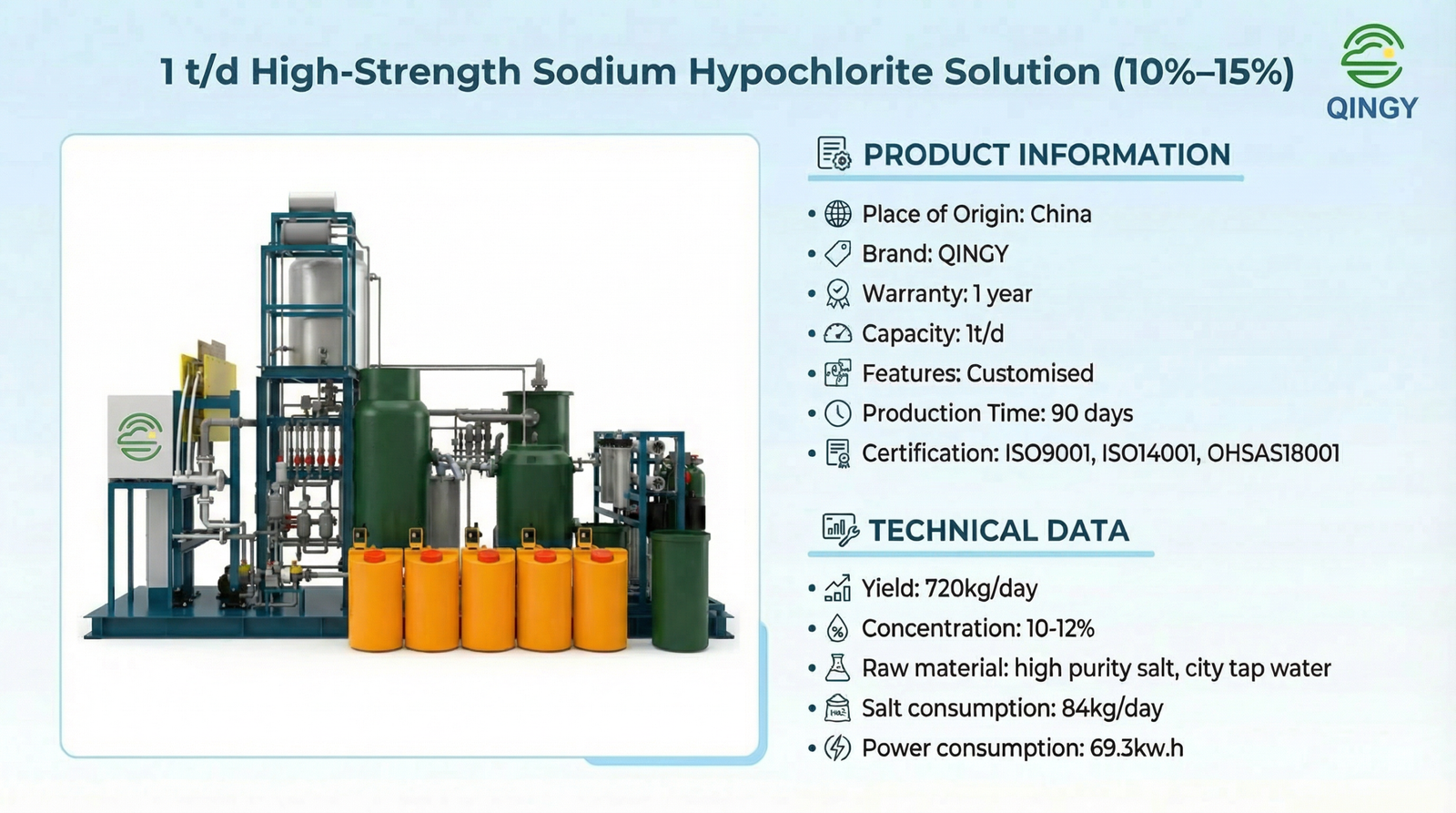
## Key Components of High-Concentration Systems
High-concentration sodium hypochlorite generators incorporate specialized components to achieve their enhanced performance:
– **High-efficiency electrolytic cells**: Featuring advanced electrode materials such as ruthenium-iridium oxide coatings on titanium substrates, designed to withstand higher current densities
– **Membrane technology**: Selectively permeable membranes that separate the anode and cathode chambers, preventing back-migration of products and enhancing concentration
– **Precision brine system**: Capable of producing and delivering highly concentrated salt solutions with consistent quality
– **Advanced power supply**: High-current, precisely controlled DC power with adjustable voltage and current regulation
– **Temperature management system**: Critical for maintaining optimal reaction conditions at higher concentrations
– **Pressure control mechanisms**: To ensure proper flow dynamics through the electrolytic cell
– **Specialized storage solutions**: For the more concentrated and potentially more reactive product
The membrane technology, often utilizing perfluorinated ion-exchange membranes, is particularly crucial in high-concentration systems, allowing for efficient ion transport while preventing product dilution.
## Critical Technical Specifications for High-Concentration Models
When evaluating high-concentration sodium hypochlorite generators, these technical specifications are particularly important:
1. **Production capacity**: Measured in kg of available chlorine per hour (kg/h). High-concentration systems typically range from 0.5 kg/h to over 100 kg/h for industrial-scale units.
2. **Product concentration**: The strength of the generated solution, typically 3-8% available chlorine. This is the defining characteristic of high-concentration systems.
3. **Current density**: The amount of current per unit area of electrode surface, typically 2000-6000 A/m² for high-concentration systems (compared to 500-2000 A/m² for standard models).
4. **Energy efficiency**: Expressed as kWh per kg of chlorine (kWh/kg Cl₂). High-concentration systems typically range from 5.5-8.5 kWh/kg Cl₂, with more efficient systems approaching the lower end of this range.
5. **Salt efficiency**: The ratio of chlorine produced to salt consumed, typically 25-35% conversion efficiency for high-concentration systems.
6. **Membrane performance**: Key indicators include ion exchange capacity, electrical resistance, and chemical stability under high-concentration conditions.
7. **Operating pressure**: High-concentration systems often operate at elevated pressures (0.5-3 bar) to maintain proper flow dynamics through the electrolytic cell.
8. **Temperature range**: Optimal operation typically occurs between 30-50°C, with precise temperature control essential for maintaining product quality and system efficiency.
## Applications and Advantages of High-Concentration Systems
High-concentration sodium hypochlorite generators are particularly well-suited for:
– **Large-scale municipal water treatment**: Where high volumes of disinfectant are required
– **Industrial wastewater treatment**: For processing plants with substantial disinfection needs
– **Oil and gas industry**: For water treatment in extraction and refining operations
– **Pulp and paper manufacturing**: For bleaching processes and water treatment
– **Large commercial swimming facilities**: Where high-capacity disinfection is needed
– **Mining operations**: For process water treatment and effluent management
The key advantages of high-concentration systems include:
– Reduced storage requirements due to higher product concentration
– Lower transportation costs for the final product
– Enhanced disinfection power for challenging water treatment applications
– Improved efficiency in certain industrial processes requiring higher concentrations
– Reduced dilution water requirements when the product is used
## Operational Considerations and Maintenance Requirements
High-concentration sodium hypochlorite generators require specialized operational protocols and maintenance:
– **Strict quality control**: For both incoming salt and water to prevent electrode and membrane fouling
– **Regular membrane inspection and replacement**: Typically every 2-5 years depending on operating conditions
– **Precise control of operating parameters**: Including temperature, current density, and flow rates
– **Specialized cleaning procedures**: To maintain electrode and membrane performance
– **Enhanced safety protocols**: Due to the higher concentration and reactivity of the product
– **Corrosion-resistant materials**: Throughout the system to handle the more aggressive solution
With proper maintenance and operation, high-concentration systems can achieve electrode lifespans of 3-7 years and membrane lifespans of 2-5 years, with overall system longevity comparable to standard models when properly maintained.
High-concentration sodium hypochlorite generators represent a significant advancement in on-site disinfection technology, offering enhanced performance for industrial and large-scale applications. By understanding their specialized working principles and technical specifications, facilities can select systems that deliver powerful disinfection capabilities while optimizing operational efficiency and safety.
Learn more about our sodium hypochlorite generator and high concentration sodium hypochlorite generator for industrial disinfection applications.