
Sodium hypochlorite, the active ingredient in household bleach, is a powerful disinfectant essential for water treatment, industrial sanitation, and public health. While low-concentration solutions are common, high concentration sodium hypochlorite generators produce a more potent, stable form of this chemical on-site. This article explains the technology behind these systems, their components, and the benefits of high-concentration production.
## The Science Behind Sodium Hypochlorite Generation
High concentration sodium hypochlorite generators use electrolysis to transform saltwater (brine) into a concentrated disinfectant solution. The process differs from standard bleach production by optimizing conditions to achieve higher active chlorine levels—typically 8-15% compared to household bleach’s 5-6%.
The core chemical reaction occurs when an electric current passes through a brine solution:
NaCl + H₂O → NaOCl + H₂
This reaction produces sodium hypochlorite (NaOCl) and hydrogen gas. In high-concentration systems, specialized electrolyzers and optimized operating parameters maximize the conversion efficiency of salt to sodium hypochlorite.
## Key Components of High Concentration Systems
A complete high concentration sodium hypochlorite generator system includes several specialized components:
– **Brine Preparation Unit**: Creates a concentrated saltwater solution (typically 25-30% NaCl) using high-purity salt to ensure product quality.
– **Electrolyzer**: The system’s core, featuring specialized electrodes and membranes designed for high-concentration production.
– **Power Supply**: Delivers precise electrical current with adjustable voltage to maintain optimal electrolysis conditions.
– **Cooling System**: Controls temperature during electrolysis to prevent decomposition of the high-concentration solution.
– **Product Stabilization Unit**: Adjusts pH and adds stabilizers to enhance the shelf life of the concentrated solution.
– **Control Panel**: Monitors and regulates all system parameters including temperature, current density, and product concentration.
## The Generation Process Step-by-Step
High concentration sodium hypochlorite production follows a precise sequence:
1. **Brine Preparation**: High-purity salt dissolves in water to create a concentrated solution. The quality of salt is critical—impurities can reduce efficiency and contaminate the final product.
2. **Pre-Treatment**: The brine undergoes filtration and softening to remove calcium, magnesium, and other minerals that could foul electrodes or reduce concentration levels.
3. **Electrolysis**: The purified brine enters the electrolyzer where:
– At the anode: Chloride ions (Cl⁻) lose electrons and form chlorine gas (Cl₂)
– At the cathode: Water molecules split into hydrogen gas (H₂) and hydroxide ions (OH⁻)
– In solution: Chlorine gas reacts with hydroxide ions to form hypochlorite ions (OCl⁻)
4. **Concentration Optimization**: Specialized electrolyzer design with narrow electrode gaps and optimized current density maximizes hypochlorite production while minimizing side reactions.
5. **Product Separation**: The system separates the hydrogen gas (vented or collected) from the sodium hypochlorite solution.
6. **Stabilization**: The concentrated solution receives pH adjustment and stabilizers to prevent decomposition, ensuring a shelf life of 3-6 months.
## Technology Advancements in High Concentration Systems
Modern high concentration generators incorporate several technological innovations:
– **Titanium Electrodes with Noble Metal Coatings**: Provide corrosion resistance and maintain efficiency over extended periods.
– **Membrane Cell Technology**: Uses ion-exchange membranes to prevent back-reaction of products, increasing concentration levels.
– **Variable Frequency Drives**: Allow precise control of electrical parameters to maintain consistent concentration regardless of operating conditions.
– **Automated Monitoring Systems**: Continuously measure product concentration, temperature, and flow rates to maintain optimal performance.
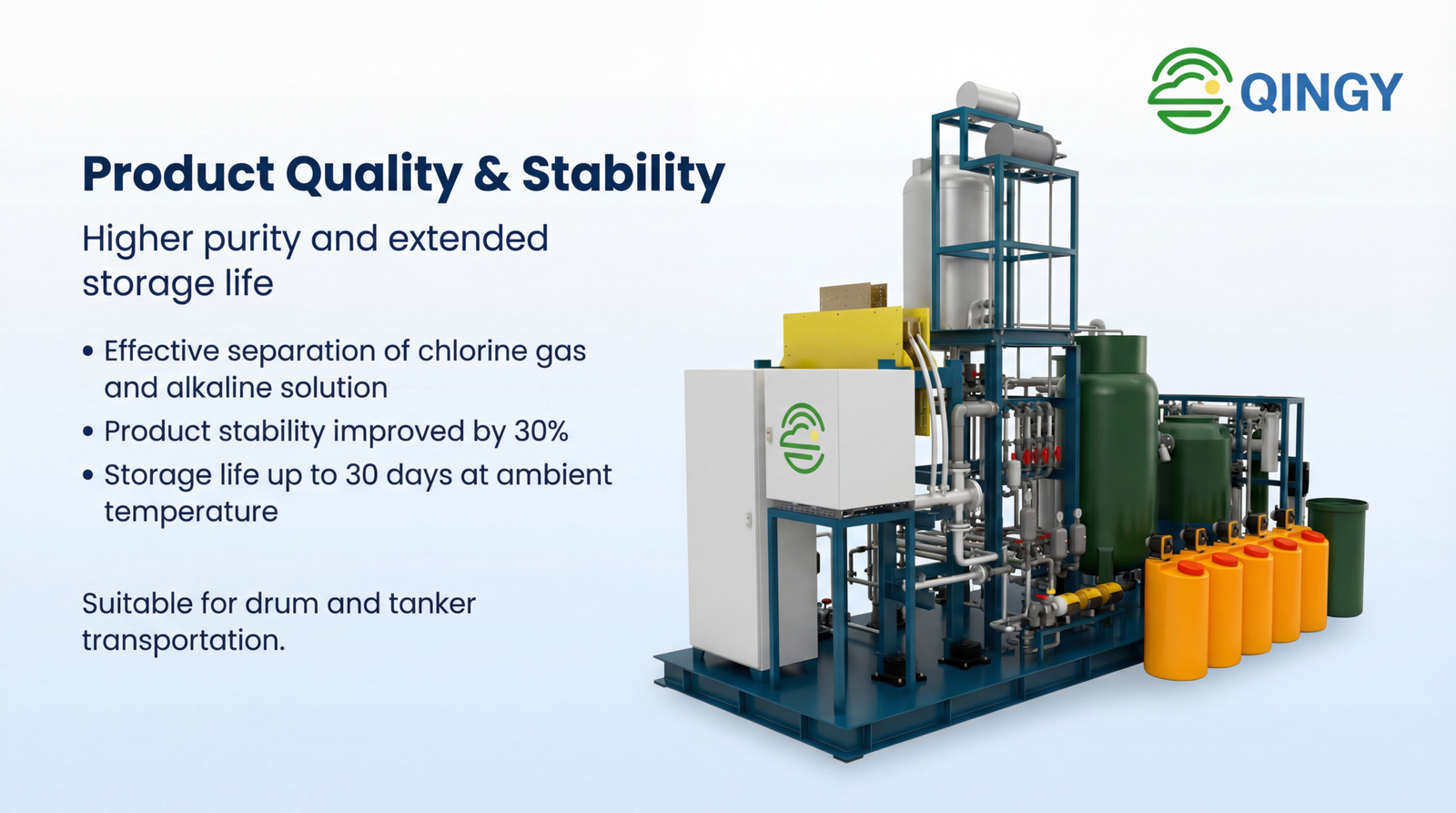
## Benefits of High Concentration Sodium Hypochlorite
Producing high concentration sodium hypochlorite on-site offers significant advantages:
– **Cost Efficiency**: Higher concentration reduces storage and transportation requirements by 50-70% compared to standard solutions.
– **Enhanced Stability**: Concentrated solutions (8-15%) have better shelf stability than dilute versions, reducing waste.
– **Reduced Logistics**: Fewer deliveries of raw materials (salt vs. finished bleach) lower transportation costs and environmental impact.
– **Improved Disinfection**: Higher concentration solutions provide more effective disinfection with lower dosage requirements.
– **Safety**: On-site production eliminates risks associated with transporting and storing large quantities of hazardous chemicals.
## Applications of High Concentration Solutions
High concentration sodium hypochlorite finds applications across multiple industries:
– **Municipal Water Treatment**: Used for drinking water disinfection and wastewater treatment with reduced storage needs.
– **Industrial Process Water**: Treats cooling tower water and process water in manufacturing facilities.
– **Food and Beverage Industry**: Provides powerful sanitation for processing equipment and surfaces.
– **Oil and Gas Industry**: Treats produced water and maintains water quality in drilling operations.
– **Agriculture**: Disinfects irrigation water and agricultural equipment.
## Operational Considerations
To maintain optimal performance of high concentration sodium hypochlorite generators:
– Use only high-purity salt to prevent electrode fouling and product contamination.
– Regularly monitor and maintain electrolyzer membranes and electrodes.
– Implement proper ventilation for hydrogen gas produced during electrolysis.
– Store the concentrated solution in corrosion-resistant tanks at controlled temperatures.
## Conclusion
High concentration sodium hypochlorite generators represent a significant advancement in on-site chemical production technology. By understanding how these systems work, facilities can implement more efficient, cost-effective, and safer disinfection solutions.
The technology offers particular benefits for large-scale users requiring consistent, high-quality disinfectant. As water treatment standards become more stringent and sustainability concerns grow, high concentration sodium hypochlorite generators will continue to gain adoption across industries seeking reliable, efficient disinfection solutions.
If your organization requires large volumes of disinfectant for water treatment or sanitation, a high concentration sodium hypochlorite generator could provide substantial cost savings, operational benefits, and environmental advantages compared to traditional chemical procurement methods.
Learn more about our sodium hypochlorite generator and high concentration sodium hypochlorite generator for industrial disinfection applications.