
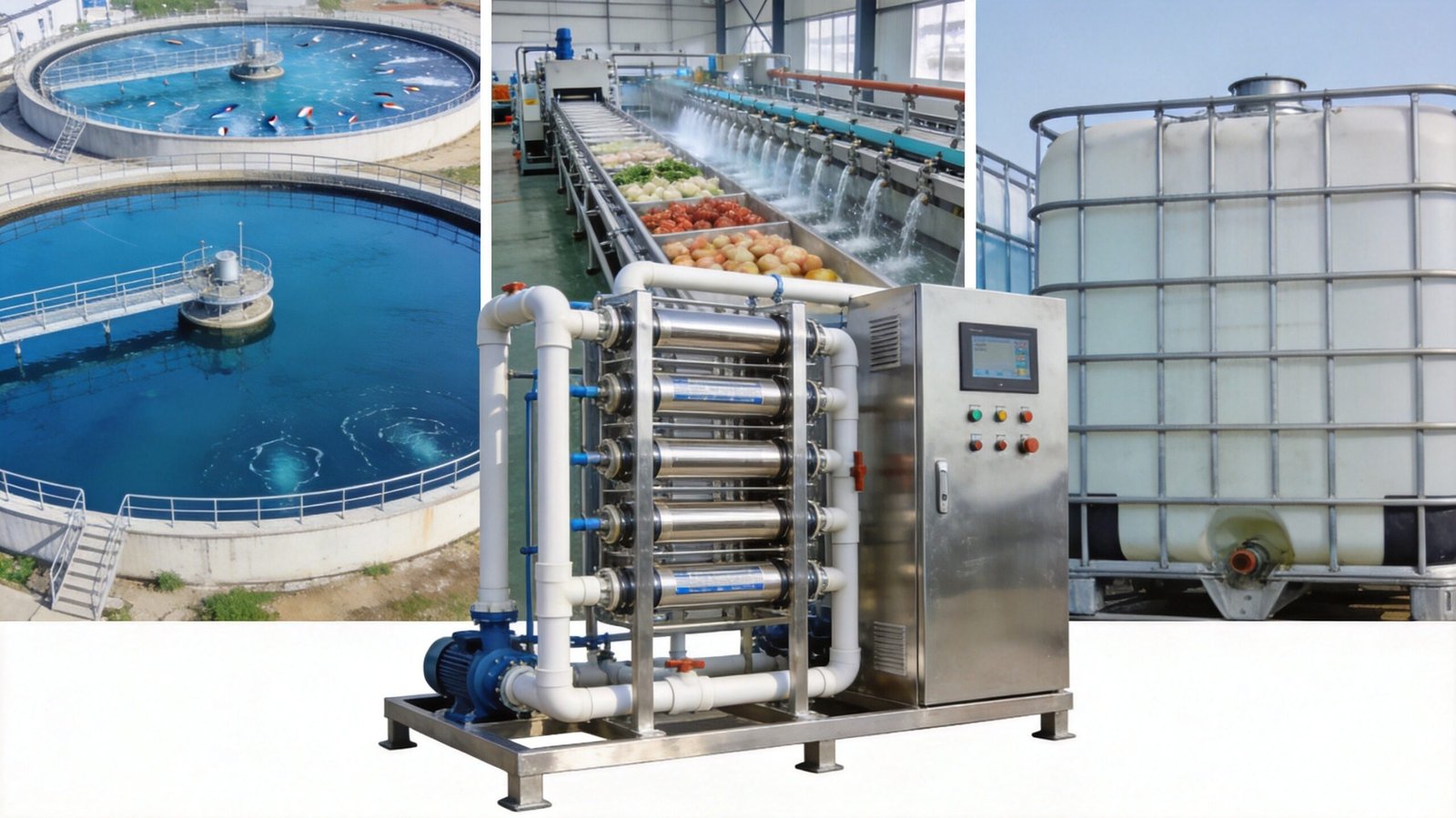
Ask a water treatment engineer what an on-site hypochlorite system is for and most will answer “drinking water disinfection.” That answer undersells the technology by a wide margin. The range of on-site electrochlorination applications we commission every year stretches from shrimp hatcheries in Southeast Asia to poultry processing lines in Brazil and produced-water treatment pads in Middle Eastern oilfields. Anywhere a process needs a controllable, fresh oxidant without the hazards of chlorine gas or the degradation losses of delivered commercial bleach, on-site generation earns its place. This guide maps the major industrial uses outside municipal disinfection, with the dose ranges, sizing logic and design details that decide whether each one succeeds.
Table of Contents
- Why On-Site Electrochlorination Applications Extend Beyond Disinfection
- Aquaculture, Hatcheries and Recirculating Aquaculture Systems
- Food and Beverage Processing
- Industrial Cooling and Biofouling Control
- Oil, Gas and Mining Operations
- Chemical Oxidation Duties: Odor, Cyanide, Ammonia and Metals
- Sizing a Generator for Non-Municipal Duties
- Engineering Details That Decide Success
- Frequently Asked Questions
Why On-Site Electrochlorination Applications Extend Beyond Disinfection
Sodium hypochlorite is fundamentally an oxidant delivery vehicle. Disinfection — the inactivation of bacteria, viruses and protozoa — is only one expression of its chemistry. The same free available chlorine (FAC) that kills E. coli also oxidizes hydrogen sulfide, destroys cyanide, breaks down ammonia, precipitates iron and manganese, strips biofilm from heat-transfer surfaces, and sanitizes food-contact equipment. What changes from duty to duty is not the chemistry but the required dose, the control philosophy, and the acceptable residual.
On-site generation adds three properties that make these industrial uses practical:
- Fresh, full-strength oxidant. Commercial bulk hypochlorite loses 2–4% of its available chlorine per month at ambient temperature — faster in hot climates. A generator produces product that is dosed within hours or days, so the dose you meter is the dose the process receives. For oxidation reactions with tight stoichiometry (breakpoint chlorination, cyanide destruction), this predictability matters more than the headline concentration.
- No hazardous logistics. Chlorine gas is cheap per kilogram but carries regulatory, safety and security burdens that many food plants, farms and remote sites simply will not accept. Salt, water and electricity are available almost everywhere.
- High concentration without instability. QINGY membrane-cell generators produce 10–15% available chlorine — strong enough that storage volumes and dosing pump sizes shrink dramatically compared with 0.8% low-concentration systems, yet inherently more stable than 15% commercial bleach because the product is fresh, low in chlorate, and properly buffered. The chemistry behind that stability is covered in our article on sodium hypochlorite stability and degradation prevention.
The result: most on-site electrochlorination applications outside municipal water treatment are not experimental — they are mature, code-referenced uses that simply need correct sizing and control.
Aquaculture, Hatcheries and Recirculating Aquaculture Systems
Electrochlorination for aquaculture is a disinfection paradox: the water must be pathogen-free, but the animals themselves are exquisitely sensitive to chlorine. Most farmed fish show stress at 0.02–0.05 mg/L FAC, and larvae at far less. On-site electrochlorination resolves the paradox by separating disinfection from exposure — you chlorinate the incoming or recirculated water, allow contact time, then remove the residual before it reaches the animals.
Where the oxidant is applied
- Influent water disinfection. Intake water from estuaries, wells or surface sources carries Vibrio, parasites and viral particles. A dose of 1–3 mg/L FAC with 20–30 minutes of contact in a retention tank, followed by activated-carbon or sodium thiosulfate dechlorination, delivers pathogen-free make-up water. Hatcheries producing shrimp post-larvae and marine finfish fry depend on this barrier.
- RAS side-stream treatment. In recirculating aquaculture systems, a slipstream of 5–10% of total flow can be dosed, contacted and dechlorinated to control heterotrophic bacterial load without exposing fish. Ozone is common in high-value marine RAS, but hypochlorite is simpler and far cheaper for freshwater systems and for tank/equipment sanitation between batches.
- System and equipment sanitation. Between production cycles, tanks, pipes and biofilters are disinfected at 20–50 mg/L FAC. High-concentration product makes this practical: a 12% solution diluted to 50 mg/L means only about 0.4 L of product per cubic metre treated, so a single 200 L drum services a large farm.
- Bloodwater and effluent treatment. Processing effluent with high organic load is disinfected before discharge, with doses set by demand testing rather than a fixed residual.
Sizing follows the make-up and side-stream flows, not the total pond volume — a distinction that keeps generators small. A hatchery drawing 100 m³/h of intake water at 2 mg/L needs just 4.8 kg/day of chlorine, comfortably served by a small continuous generator running at partial load. Detailed demand calculations follow the method in our chlorine demand calculation guide.
Food and Beverage Processing
Food processing is one of the most regulated settings for industrial electrochlorination, and also one of the most forgiving in dose terms — because the doses are small but the water volumes can be large. The breadth of sodium hypochlorite generator applications in this sector surprises many first-time buyers.
Produce washing and flume water
Fresh-cut and whole produce operations recirculate wash and flume water that can cross-contaminate entire batches with a single contaminated item. Maintaining 25–100 mg/L FAC in wash water (commodity-dependent), controlled by ORP around 650–750 mV, is standard industry practice and aligns with the agricultural water provisions of the US FDA FSMA Produce Safety Rule. On-site generation fits these plants because wash lines run 12–16 hours daily and fresh product avoids the potency uncertainty of stored bleach — a quality-audit point, not just an operational one.
Poultry and meat processing
Carcass wash, chiller water and equipment sanitation typically run at 20–50 mg/L FAC. A mid-size poultry plant processing 100,000 birds per day may circulate 500–1,000 m³ of chiller water; at a make-up-driven demand of 3–5 mg/L the chlorine consumption is only a few kilograms per hour, well within a compact skid.
CIP and general sanitation
Dairy, beverage and brewery clean-in-place cycles use alkaline chlorinated detergents and final sanitizing rinses at 100–200 mg/L. High-concentration product is an advantage here: dosing 12% NaClO into a CIP make-up tank requires simple metering equipment, and the on-site generator removes dependence on chemical deliveries in remote plant locations. Breweries and bottlers also use hypochlorite for crate and bottle washing and for treating process-water recovery loops.
Industrial Cooling and Biofouling Control
Cooling water is the largest-volume industrial use of oxidizing biocide, and it splits into two distinct designs:
Recirculating cooling towers
Evaporative towers concentrate nutrients and run warm — ideal conditions for Legionella, algae and biofilm. Continuous low-dose chlorination holding 0.1–0.5 mg/L free residual in the return line, supplemented by periodic shock doses, keeps plates and fill clean. Chlorine demand is dominated by make-up water quality and process leaks; a refinery tower circulating 10,000 m³/h with 1.5% blowdown might consume 30–60 kg/day. Because on-site generation scales linearly, one skid can serve multiple cells with individual dosing points.
Once-through seawater cooling
Coastal power stations, LNG terminals and desalination plants fight macrofouling — mussels, barnacles and hydroids colonizing intake structures and condenser tubes. Continuous dosing of 0.2–1.0 mg/L at the intake, targeting 0.1–0.2 mg/L residual at the condenser outlet, prevents settlement without tripping discharge limits. Seawater electrochlorination generates hypochlorite directly from the cooling water itself, eliminating the salt supply entirely; our complete guide to seawater electrochlorination covers cell design for that duty, and the power-station specifics are in our power plant cooling water treatment article.
Ballast water
Electrochlorination is the dominant technology in shipboard ballast water treatment, producing a 1–10 mg/L total residual oxidant dose during ballast uptake to meet IMO D-2 discharge standards. Marine systems are a specialized design branch, but the electrolyzer fundamentals are identical.
Oil, Gas and Mining Operations
Few environments punish equipment like oilfield water treatment, yet the oxidant duties are clear-cut:
- Produced water and injection water. Sulfate-reducing bacteria (SRB) sour reservoirs and corrode tubing. Maintaining an oxidant residual in water-flood injection systems — typically 50–200 mg/L applied intermittently or continuously depending on demand — suppresses SRB and removes sulfide already present. On-site generation is often the only credible supply chain for remote pads and offshore platforms, where it pairs with seawater or produced-brine electrolysis.
- Hydraulic fracturing water. Frac water is disinfected to protect gelling agents from bacterial degradation and the reservoir from contamination. Doses of 5–25 mg/L on water that may arrive at 5–15 m³/min demand trailer-mounted generators with high instantaneous output — a case where 10–15% product concentration directly reduces skid size and chemical storage footprint.
- Mining process water. Heap-leach operations and mineral processing plants use hypochlorite for biofouling control in process-water circuits and for cyanide destruction in gold-mine effluent (below).
Materials selection is critical in these services — produced water can be hot, saline and hydrocarbon-contaminated. Our materials of construction guide for high-concentration systems details the FRP, CPVC, titanium and elastomer choices that survive.
Chemical Oxidation Duties: Odor, Cyanide, Ammonia and Metals
Beyond biological control, hypochlorite is a workhorse oxidant in chemical treatment. These duties are stoichiometric: the dose follows the contaminant load, and an under-strength or degraded oxidant shows up immediately as unreacted contaminant.
Hydrogen sulfide and odor control
In collection systems, wet wells and scrubbers, hypochlorite oxidizes H₂S — about 2.2 mg Cl₂ per mg H₂S to elemental sulfur, and roughly 8.4 mg per mg when carried through to sulfate. Practical scrubber and dosing designs use 3–10 mg per mg depending on contact time and target endpoint. On-site generation suits municipal lift stations and industrial scrubbers that lack bulk chemical delivery infrastructure.
Cyanide destruction
Alkaline chlorination remains a reference method for cyanide-bearing effluent from metal finishing and gold processing. The first stage (CN → cyanate, pH > 10.5) needs about 2.7 mg Cl₂ per mg CN; complete destruction to nitrogen and bicarbonate totals roughly 6.8 mg per mg. Precise dosing matters — under-dosing risks toxic cyanogen chloride formation — which favors fresh, known-strength oxidant from a generator feeding a properly instrumented dosing skid like those in our sodium hypochlorite dosing system design guide.
Ammonia removal by breakpoint chlorination
Oxidizing ammonia to nitrogen gas requires a theoretical 7.6 mg Cl₂ per mg NH₃-N, and 8–10:1 in practice once competing demands are included. It is used for polishing low ammonia concentrations where biological nitrification is impractical — landfill leachate side-streams, some industrial effluents, and emergency treatment.
Iron and manganese oxidation
Hypochlorite oxidizes dissolved Fe²⁺ (0.62 mg Cl₂ per mg Fe) and Mn²⁺ (0.77 mg per mg theoretical; allow 1.0–1.5 in practice with pH control) so the metals precipitate and filter out. Groundwater-fed industrial plants frequently combine this duty with disinfection in a single dose.
Sizing a Generator for Non-Municipal Duties
Sizing logic is identical across all on-site electrochlorination applications: peak flow × worst-case demand defines instantaneous capacity, and average daily consumption defines running cost. The differences lie in the demand basis:
| Application | Typical FAC Dose | Demand Basis | Design Note |
|---|---|---|---|
| Aquaculture influent | 1–3 mg/L | Make-up / side-stream flow | Dechlorination downstream mandatory |
| Produce wash water | 25–100 mg/L | Recirculated flume volume + organic load | ORP-controlled dosing |
| Cooling tower | 0.1–0.5 mg/L residual | Make-up water + blowdown | Continuous + shock strategy |
| Once-through seawater | 0.2–1.0 mg/L | Full intake flow | Seawater electrochlorination, no salt supply |
| Produced / frac water | 5–200 mg/L | Batch volume, SRB load | High instantaneous capacity, mobile skids |
| Cyanide destruction | 6.8 mg Cl₂ per mg CN | Stoichiometric + pH control | Two-stage reaction tanks |
Two sizing rules deserve emphasis. First, demand testing beats assumptions: for organic-laden waters (produce wash, effluent, produced water), run a jar-test demand curve before fixing generator capacity — the chlorine demand of the water often exceeds the target residual by a factor of three or more. Second, high concentration reduces the entire balance of plant: producing 12% available chlorine instead of 0.8% cuts product storage volume by 93%, shrinks dosing pumps into simple metering units, and makes multi-point dosing from one generator practical. For capital-cost context against delivered chemicals, see our on-site generation vs. bulk delivery TCO analysis.
Engineering Details That Decide Success
Across the hundreds of industrial installations behind these applications, the failure modes repeat. Five design points eliminate most of them:
- Control philosophy matched to the duty. Residual control (cooling, wash water) needs online amperometric or DPD feedback; stoichiometric duties (cyanide, ammonia) need flow-paced feed-forward with ORP or analyzers trimming. A single control mode rarely covers both.
- Dilution water quality. Where 10–15% product is diluted before injection, hardness in the dilution water precipitates in dosing lines. Softened or RO dilution water and periodic line flushing prevent the classic blocked-injector failure.
- Storage sized to generation rate, not habit. Fresh product is the whole point; a common mistake is over-sized tanks that re-create the degradation problem of bulk bleach. Size storage for 1–3 days of average demand with duty/standby generation capacity.
- Ventilation and hydrogen management. Every electrolyzer produces hydrogen at the cathode. Even compact skids need engineered degassing and ventilation, as detailed in our hydrogen safety engineering guide.
- Ambient-temperature derating. Food plants and aquaculture facilities in tropical climates need cooling and ventilation sized for the equipment room, not just the cell — see the heat-load method in our generator cooling system design article.
Frequently Asked Questions
Can on-site electrochlorination be used for applications besides water disinfection?
Yes — disinfection is only one duty. The same generated hypochlorite handles biofouling control in cooling systems, produce and equipment sanitation in food plants, odor control (H₂S oxidation), cyanide destruction, ammonia breakpoint chlorination, and iron/manganese oxidation. The generator is identical; only the dosing rate, control philosophy and residual target change.
Is on-site generated hypochlorite approved for food-processing use?
Sodium hypochlorite is an accepted antimicrobial for produce wash water and food-contact surface sanitation under US FDA and EPA frameworks, provided use follows concentration and labeling requirements. On-site generated product is chemically the same NaClO; plants should document concentration verification and include it in their food-safety plan, just as they would for delivered chemical.
How do I control chlorine residual in aquaculture without harming fish?
Never dose into fish-contact water directly. Disinfect influent or a side-stream in a contact tank, then remove residual with activated carbon or a reducing agent before the water reaches animals. Verify with online residual analyzers reading below 0.02 mg/L at the culture tank inlet, with alarm and shutoff interlocks.
What generator capacity do I need for a cooling tower?
Start from make-up flow and demand, not circulation rate: Capacity (kg/day) ≈ make-up (m³/day) × total demand (mg/L) ÷ 1,000, plus shock-dose allowance. A 10,000 m³/h tower with 1.5% blowdown and 4 mg/L total demand needs roughly 55 kg/day — a single 3 kg/h generator with storage covers it with margin.
Does high-concentration (10–15%) product make sense for small applications?
Usually yes. High concentration shrinks storage tanks, dosing pumps and footprints at every scale, and modern membrane-cell skids from 1 kg/day upward are fully automatic. The exception is ultra-small, unmanned sites where the simplicity of low-concentration batch systems outweighs logistics savings — a trade-off we assess case by case.
Evaluating on-site electrochlorination applications for aquaculture, food processing, cooling or chemical oxidation duty? QINGY designs and manufactures 1–10 t/d high-concentration (10–15%) sodium hypochlorite generation systems with application-specific dosing and control packages. Send us your flow rate and water analysis — our engineers will return a sizing and dosing concept within days.